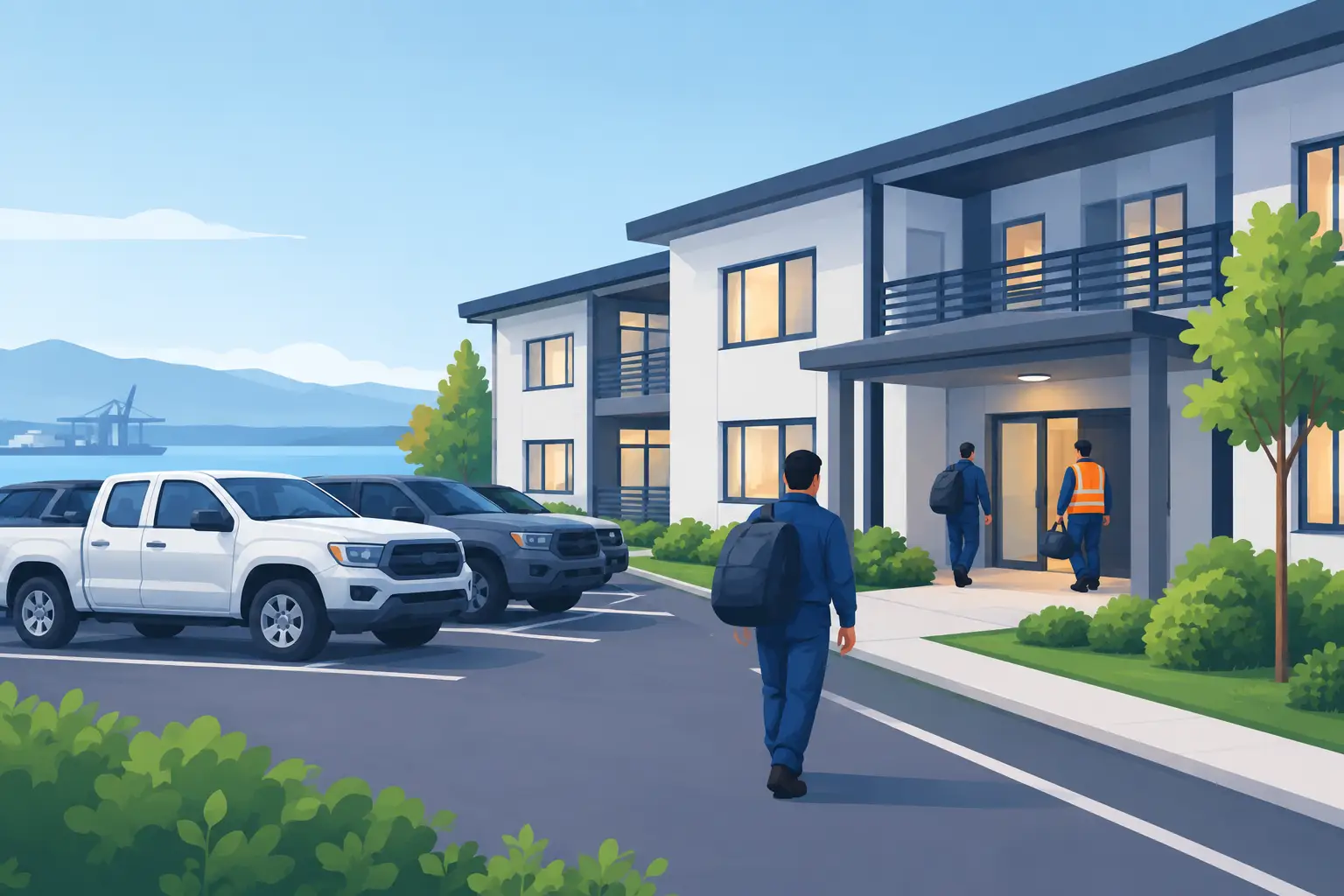
When a project starts at 6 a.m. and the site is 45 minutes from the nearest practical housing option, the cost shows up fast. Workers lose time in transit, shifts become harder to manage, and hotel bookings start multiplying into a budget problem. That is why worker lodging near industrial sites is not just a housing issue. It is an operations decision.
For companies managing technicians, contractors, maintenance crews, or installation teams, the right accommodation has to do more than provide beds. It needs to support schedules, reduce travel friction, keep teams comfortable over weeks or months, and stay simple to manage from an administrative standpoint. In industrial environments, convenience is measurable. If lodging is close to the work, fully equipped, and built for group occupancy, the job runs more smoothly.
Why worker lodging near industrial sites matters
Industrial projects are rarely organized around leisure travel patterns. Teams may arrive on short notice. Headcounts may change. Working hours may start early, end late, or rotate across shifts. In that context, standard hotel booking is often the default, but not always the best fit.
Hotels can work for short individual stays, especially when a company only needs one or two rooms for a few nights. The trade-off appears when the stay extends beyond a week or when several workers need to stay in the same area. Costs rise quickly, meals become inconsistent, and teams lose the practical benefits of shared accommodation.
Furnished houses and apartments near industrial zones solve a different problem. They give companies a place where teams can live, cook, rest, and stay organized during the assignment. That matters for productivity, but it also matters for retention. Workers sent to demanding project locations generally perform better when housing is comfortable and functional rather than improvised.
What companies should look for in worker lodging near industrial sites
Location is the first filter, but it should not be the only one. A property can appear close on a map and still create daily complications if access roads are poor, parking is limited, or the route adds unnecessary delay at shift changes. Proximity should be evaluated in practical terms - actual travel time, local traffic conditions, and ease of reaching the site reliably every day.
Capacity matters just as much. Many industrial assignments involve crews, not solo travelers. Booking separate rooms in multiple properties may seem manageable at first, but it creates more coordination, more invoices, and less control over where people are staying. Group accommodation in a single house or apartment is usually easier to manage and often more cost-effective over a medium-term stay.
The property also needs to be ready for immediate use. That means furnished bedrooms, equipped kitchens, working appliances, internet access, utilities already active, and enough common space for a team to function without feeling crowded. If a company has to arrange furniture, install services, or solve basic setup issues after arrival, the accommodation is not truly operational.
Contract flexibility is another major factor. Industrial work does not always fit a perfect calendar. A shutdown can be extended. A new phase can start earlier than expected. Staffing levels can expand after a client request. Housing should allow for realistic business adjustments without forcing a company into rigid terms that no longer match the project.
Hotels vs. furnished team housing
For decision-makers, this comparison usually comes down to duration, group size, and control.
Hotels are simple to book, but they are built around short stays and individual occupancy. They can be expensive for multi-week assignments, especially when breakfast, parking, laundry, and evening meals are added to the base room rate. They also separate workers across rooms and sometimes across properties, which makes transportation and supervision more difficult.
Furnished team housing is typically better suited for crews staying one month or longer. The per-person cost is often lower, especially when several workers share one property designed for professional occupancy. A kitchen allows teams to prepare meals, which reduces daily spending. Shared living space also creates a more stable routine for workers who are away from home for extended periods.
That said, it depends on the assignment. If the project is very short, a hotel may still be the practical answer. If the project is longer, involves a team, or requires recurring housing in the same region, furnished corporate accommodation usually makes more operational and financial sense.
The hidden costs of getting lodging wrong
Accommodation decisions are often evaluated on nightly rate alone. That is a mistake.
If workers spend too much time commuting, the company pays for it through lost hours, reduced flexibility, and greater transport coordination. If the property is poorly equipped, workers spend more on meals or ask for additional support. If invoices come from multiple providers with different terms, the administrative load increases. If the team is uncomfortable, turnover risk can rise during longer projects.
These are not abstract concerns. They affect site readiness, workforce stability, and budget accuracy. In practical terms, the wrong lodging option can create friction every day, while the right one disappears into the background and lets the work proceed.
What a good setup looks like in practice
The strongest lodging setup near an industrial site is usually simple. The property is close enough to reduce daily travel. It is large enough to house the full team or a defined unit of the team. It is furnished and equipped from day one. Billing is clear. The contract reflects the likely duration of the assignment without becoming a constraint if conditions change.
For many employers, all-inclusive pricing is especially useful. One monthly amount covering furniture, utilities, Wi-Fi, and standard living needs makes budgeting easier. Procurement teams can compare options faster, and finance teams spend less time reconciling variable charges.
There is also a management benefit when one provider handles the accommodation rather than several different landlords or booking platforms. Communication is faster, issue resolution is clearer, and the company has a single point of contact for availability, extensions, and occupancy questions.
Choosing lodging for different industrial scenarios
Not every project requires the same housing model. A maintenance shutdown with a 12-person crew has different needs than a six-week installation involving four specialists. A relocation assignment may require more privacy, while a field team focused on cost control may prioritize shared occupancy and easy access to highways or logistics corridors.
That is why companies should match the lodging format to the actual deployment. For larger teams, houses and apartments designed for 6 to 16 occupants provide a practical balance between capacity and comfort. For medium-term stays, ready-to-live-in housing reduces setup time and avoids the complications of unfurnished rental stock. For companies operating across Belgium, consistent standards across locations can save significant time when projects move from one region to another.
This is where a specialized provider tends to outperform general rental options. Corporate housing designed for worker accommodation already accounts for the basics that project teams need: sleeping capacity, equipped kitchens, fast internet, utilities, and contracts aligned with business use rather than private residential leasing.
Administrative simplicity matters more than most teams expect
Operations managers usually focus first on location and price. After the first month, administration becomes just as important.
If the accommodation process involves multiple deposits, separate utility transfers, fragmented invoices, and inconsistent contract terms, the internal cost of management increases. HR, procurement, and finance all end up spending time on housing tasks that do not move the project forward.
A business-oriented lodging solution should reduce that burden. Company invoicing, clear monthly terms, and immediate occupancy are not minor extras. They are part of making housing workable at scale. For firms deploying workers repeatedly, that simplicity becomes a real efficiency gain.
Belga Promo is positioned around that exact need, with furnished houses and apartments in Belgium set up for professional teams rather than leisure stays. The value is straightforward: accommodation that is ready to use, suitable for groups, and easier to manage than scattered hotel bookings.
A better standard for worker housing
Companies do not need luxury accommodation near industrial areas. They need practical housing that supports the job. Clean, furnished, well-located, and operationally simple usually beats flashy but inefficient options.
The best worker lodging near industrial sites helps companies control cost without making workers absorb the inconvenience. It supports attendance, rest, and routine. It reduces administrative effort. And it gives project managers one less problem to solve while the real work is underway.
If you are arranging housing for teams, the right question is not just where people can stay. It is whether the accommodation will help the project run with less friction from day one.