
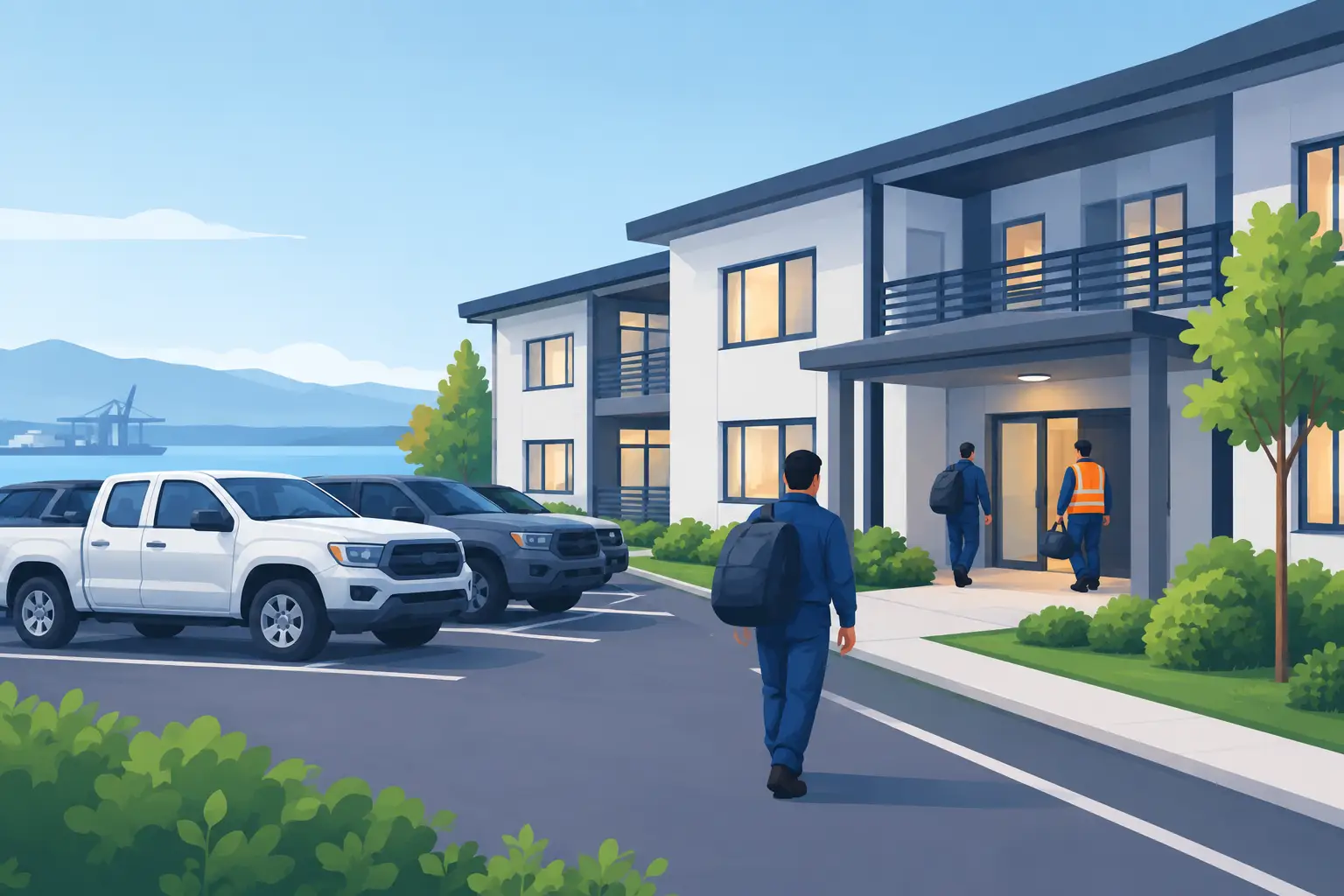
A project team can have the right people, equipment, and schedule, then lose time every morning because vehicles are scattered across public streets or parked far from the property. Crew accommodation with parking solves a practical part of workforce deployment: it gives employees a place to live and a workable base for cars, vans, tools, and daily travel.
For companies placing technicians, contractors, and site teams in Belgium, parking should be assessed alongside occupancy, location, and monthly cost. It is not an extra detail. When crews drive to industrial sites, customer locations, warehouses, or changing work areas, available parking can affect punctuality, security, fatigue, and the day-to-day coordination of the project.
Why parking changes the value of crew housing
A hotel may appear convenient for a short stay, but multiple rooms and separate parking arrangements often become difficult to manage over several weeks or months. Employees may pay different daily rates, park in public garages, or need to move vehicles before local restrictions begin. The administrative burden grows quickly when a company is coordinating several workers and multiple vehicles.
A furnished house or apartment designed for group occupancy creates a more stable setup. Crews can park close to their accommodation, travel together when appropriate, and return after late or early shifts without searching for a space. This is particularly useful for teams working outside city centers, where driving is often necessary and public transportation may not match shift times.
The financial impact is also broader than the parking fee itself. Reliable parking can reduce reimbursable expenses, prevent wasted working time, and make it easier to keep company vehicles available when needed. For a team staying one month or longer, those operational savings can matter more than a small difference in the nightly room rate.
What to check before booking crew accommodation with parking
Parking availability should be confirmed as part of the accommodation quote, not assumed from a property description. A driveway, private lot, street parking permit, or nearby public garage are very different arrangements. The right option depends on crew size, vehicle type, work schedule, and the location of the project.
Start by confirming how many spaces are available and whether they are reserved for the company. A property that houses 10 workers may not have 10 parking spaces, and that can be perfectly workable if the crew carpools or some employees use public transportation. It becomes a problem when every worker arrives in a separate vehicle and the local area has limited legal parking.
Vehicle size matters as well. Standard passenger cars fit in places that may not suit long-wheelbase vans, pickups, or vehicles carrying equipment. If a team uses service vans, ask about access width, turning space, height limitations, and whether parking is practical after dark. For crews transporting valuable tools, visibility and proximity to the entrance may be more useful than an inexpensive parking option several blocks away.
Companies should also clarify whether parking is included in the monthly rate or charged separately. A clear, all-inclusive arrangement makes budget approval and invoicing easier. If parking permits or garage subscriptions are required, confirm who organizes them, how long they take to activate, and whether the terms match the rental period.
Match the property to the working pattern
The best accommodation choice depends on how the crew works, not simply where it sleeps. A team assigned to one fixed construction site may prioritize direct road access and enough room for several vans. A maintenance crew covering different client locations may need a central position near major routes. Teams on rotating shifts need a parking setup that still works when people leave before dawn or return late at night.
For longer assignments, group housing offers benefits that hotel rooms cannot easily provide. Workers have shared living space, equipped kitchens, laundry facilities, high-speed Wi-Fi, and the ability to establish a routine. That can support comfort and morale while giving the company a more predictable monthly housing cost.
There is a trade-off. A property near a city center may put restaurants, train stations, and services within easy reach, but private parking can be more limited and local restrictions can be tighter. Accommodation farther from the center may provide easier vehicle access and more space, while adding travel time to city-based projects. The right balance should reflect the actual worksite, not a general preference for a particular city or neighborhood.
Parking should support safety and accountability
Work vehicles are business assets. When they carry tools, materials, or technical equipment, where they are parked affects risk management. Private or designated parking can make it easier for supervisors to know where vehicles are kept overnight and reduce the temptation to leave equipment exposed in unfamiliar streets.
That does not mean every project requires a gated lot. For some teams, safe public parking nearby is sufficient. The key is to make a deliberate decision based on the value of the vehicles and contents, the local environment, and the crew's arrival pattern. A site manager should know whether drivers need a permit, whether spaces are time-limited, and whether overnight parking is allowed.
Clear rules also prevent avoidable disputes. Employees should know which spaces they can use, whether visitors may park at the property, and what to do if a vehicle arrives late. If only a limited number of spaces is available, assigning them in advance is better than asking the crew to solve the issue after check-in.
Plan housing and transport as one operation
Housing decisions are often handled by HR, procurement, or a relocation coordinator, while transport is managed by the project lead. Bringing those requirements together early produces better results. The accommodation provider needs enough information to recommend a suitable option rather than simply the nearest available property.
When requesting a quote, provide the number of occupants, the required move-in date, expected rental duration, project location, and number of vehicles. It also helps to state whether the vehicles are cars or vans, whether parking must be private, and whether workers follow standard or rotating shifts. These details allow the provider to assess both capacity and practicality before the crew arrives.
For group stays, ask how the property is configured. A house for 6 to 16 people may offer a better operational fit than booking separate units, especially when the team needs to share transport, prepare meals, and communicate outside working hours. Furnished corporate housing also reduces setup work because beds, furniture, kitchens, utilities, and Wi-Fi are already in place.
Belga Promo provides fully furnished corporate accommodation in Belgium for companies that need ready-to-live-in housing for teams on medium-term and longer assignments. Combining group capacity, company invoicing, and parking requirements in one request helps create a practical housing plan instead of a collection of separate bookings.
Avoid common parking assumptions
The most frequent mistake is treating “parking nearby” as the same as parking at the property. Nearby may mean a paid garage, a public street with time limits, or spaces that are unavailable during business hours. It may still be suitable, but only after the arrangement is understood.
Another mistake is booking based only on the number of employees. Count vehicles separately. A 12-person crew might arrive in four vans, two cars, or 12 individual vehicles. The parking plan needs to reflect the real transport model, including replacement vehicles and occasional visitors.
Finally, do not assume a short commute on a map will remain short during shift changes. Access to major roads, local traffic patterns, and parking at the worksite can have a larger effect on the daily schedule than the distance between the accommodation and the project address.
A useful accommodation request is specific: state the crew size, dates, work location, vehicle count, and parking needs from the start. That gives your provider the information needed to find housing that supports the job from the first morning on site.