When a project starts in a new city, housing is rarely the first issue on paper. But once technicians, contractors, or site teams need to stay for several weeks, the wrong lodging choice creates daily friction. The real question is not simply appart hôtel ou logement équipé - it is which option works better for your timeline, your headcount, and your operating budget.
For a short solo trip, an aparthotel can be perfectly adequate. For a company housing multiple employees over one month or more, a fully equipped corporate rental is often the more practical choice. The difference shows up in cost control, team comfort, and the amount of administrative work your staff has to manage.
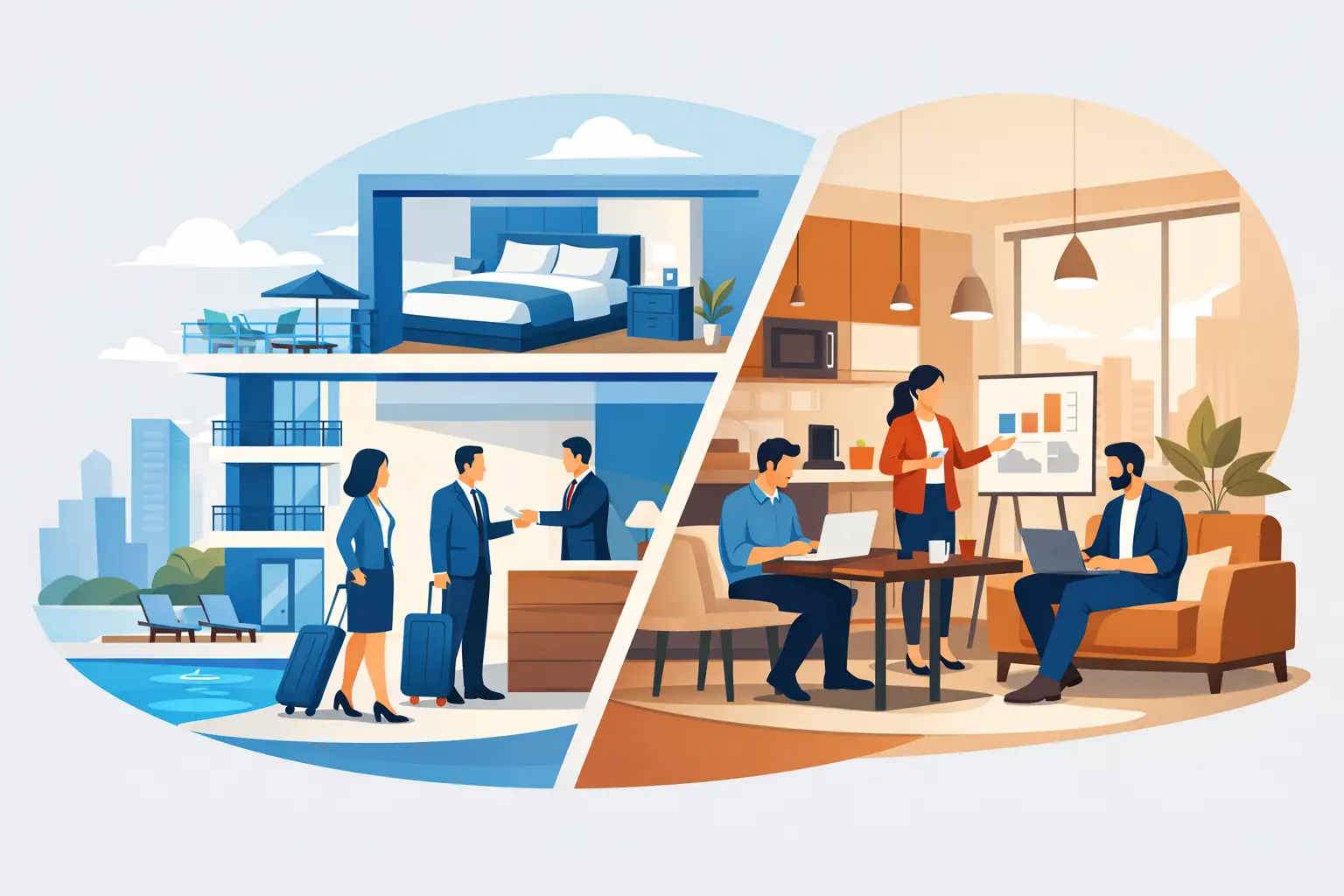
Appart hôtel ou logement équipé: what changes in practice?
An aparthotel sits somewhere between a hotel room and a small apartment. It usually offers a private bathroom, a compact kitchen, housekeeping on a set schedule, and services designed for individual business travelers or short stays. It is convenient, standardized, and easy to book for one or two people.
A logement équipé, or fully equipped furnished rental, is closer to a ready-to-live-in apartment or house. It includes furniture, beds, an equipped kitchen, Wi-Fi, utilities, and the essentials needed for immediate occupancy. In a corporate housing setup, it is designed less around overnight stays and more around daily living for employees who need a stable base near work.
That distinction matters because business housing needs change quickly once you move from one traveler to a team of six, eight, or twelve people. The larger the group and the longer the stay, the more the operational logic shifts away from hotel-style accommodation.
Cost is usually the first deciding factor
For stays of a few nights, aparthotels can be manageable. The rate is simple, and the booking process is familiar. But for assignments lasting several weeks or months, the nightly model often becomes expensive, especially when multiple rooms are needed.
A fully equipped group rental generally spreads the housing cost across more occupants and over a longer duration. That changes the budget structure in your favor. Instead of paying separate room rates, daily service costs, and repeated booking fees, your company works with one all-inclusive housing solution.
This is particularly relevant for project-based industries. If your team is deployed for installation work, maintenance, shutdown support, construction, or relocation assistance, housing can remain on the balance sheet for months. In that context, even a moderate difference in nightly cost adds up fast.
There is also a hidden cost in fragmented booking. If your staff is spread across several hotel rooms or even several properties, transport coordination, meal routines, and schedule management become less efficient. A group property reduces that operational leakage.
Comfort matters more on long assignments
Employees on extended stays do not use accommodation the same way a traveler does on a two-night business trip. They need space to cook, rest properly, do laundry, store belongings, and maintain a routine. This becomes even more important when teams are working long shifts or physically demanding jobs.
An aparthotel may offer some of that, but usually in a limited format. Rooms are often compact. Kitchens can be basic. Common living space is minimal or nonexistent. That is workable for short stays but less comfortable over time.
A logement équipé is built around actual living conditions. Separate bedrooms, shared kitchens, dining areas, living rooms, and practical storage make a visible difference in day-to-day use. Teams can prepare meals, spend time together after work, and avoid the fatigue that comes with living out of a hotel room for months.
For employers, this is not just a comfort issue. Better housing supports morale, consistency, and retention during temporary assignments. If employees are sent away from home for a long period, the quality of accommodation directly affects how sustainable the deployment feels.
Group occupancy changes the equation
Why aparthotels fit individuals better than teams
Most aparthotels are structured for one or two occupants per unit. Once your need expands to a full work crew, you are no longer buying one stay. You are managing a collection of separate stays. That creates more check-ins, more room allocations, and more chances for booking gaps.
If your workforce size changes during the project, the model becomes even harder to manage. Extending rooms, adding rooms, or relocating staff depends on availability that may shift week by week.
Why a logement équipé works better for workforce housing
A fully furnished house or large apartment designed for six to sixteen people fits the reality of team deployment much better. Your employees stay together, daily logistics are simpler, and supervision is easier for site managers or coordinators.
This setup also helps with transport planning. When the team leaves from one address near the project site, scheduling is more predictable. That may seem minor at first, but over a multi-month assignment, those practical efficiencies matter.
Administrative simplicity is often underestimated
Housing decisions are not made by travelers alone. HR, procurement, operations, finance, and project managers all end up dealing with the consequences. That is why the best accommodation option is often the one that reduces administrative load.
With aparthotels, companies may handle multiple reservations, rolling extensions, individual billing records, and changing availability. If the stay is uncertain or the workforce grows, administration becomes reactive.
With a corporate logement équipé, the structure is typically clearer. One contract, one supplier, one invoice format, and one set of included services makes internal handling easier. Utilities, furniture, Wi-Fi, and ready-to-use kitchens are already part of the arrangement, so your team avoids setting up services or reimbursing scattered expenses.
For companies operating across borders, this simplicity is especially useful. International managers often need fast housing decisions in Belgium without having local teams spend days coordinating move-in details.
Flexibility depends on the stay duration
The answer to appart hôtel ou logement équipé depends partly on how long your employees will remain on site.
If the assignment is under a week and involves one traveler, an aparthotel remains a practical option. It is straightforward and close to the hotel model most companies already know.
If the stay starts at one month, the balance shifts. At that point, employees need a proper living environment, and companies need predictable costs. The longer the duration, the stronger the case for a fully equipped rental.
This is where contract structure matters. A business housing provider focused on medium-term stays can usually offer more suitable terms than a hospitality model built around short bookings. That includes flexibility for project timelines, company invoicing, and faster occupancy.
Location should support the job, not the tourist map
Aparthotels are often concentrated in city centers and business districts. That can be useful for meetings, but it is not always ideal for industrial zones, logistics hubs, infrastructure works, or regional project sites.
A logement équipé sourced for corporate teams is often selected with practical access in mind - proximity to the workplace, transport routes, parking, and daily convenience. For employers, that is usually more relevant than having a reception desk or hotel bar.
The right location reduces commuting time and improves shift reliability. It also helps when teams start early, finish late, or need quick access to multiple job sites.
Appart hôtel ou logement équipé: a practical decision rule
If you are housing one employee for a brief assignment, an aparthotel can do the job. If you are housing several employees for weeks or months, a fully equipped group rental is usually the better business decision.
Choose based on four points: stay length, number of occupants, budget predictability, and administrative complexity. The more your situation involves extended duration, shared occupancy, and operational pressure, the less suitable the aparthotel model becomes.
That is why many companies in Belgium move toward furnished corporate housing for workforce accommodation. Providers such as Belga Promo are built around this exact need: ready-to-live-in properties for teams, flexible durations, all-inclusive pricing, and setups that match how companies actually deploy staff.
The best housing choice is the one that disappears into the background. Your employees can move in quickly, your managers can keep the project running, and your finance team is not left sorting through accommodation problems that should have been solved upfront.